Check adhesion before changing a rendered wall colour
Check adhesion before changing a rendered wall colour
A wall can look clean and still provide a poor base for a new coating. Earlier paint may be weakly attached, the render beneath may be loose or different patches may respond differently to preparation. Before approving a colour change, ask how the existing layers will be assessed and what result is needed for the proposed coating system.

On this page
Begin with the history of the surface
Collect any information about earlier render and paint work. Product names, dates and photographs can help identify the build-up. An invoice saying exterior decoration may not describe the material in enough detail, but it can still establish when a layer was added. Keep uncertain information labelled as uncertain rather than converting a recollection into a confirmed product specification.
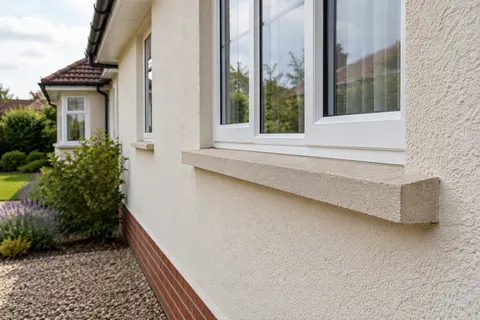
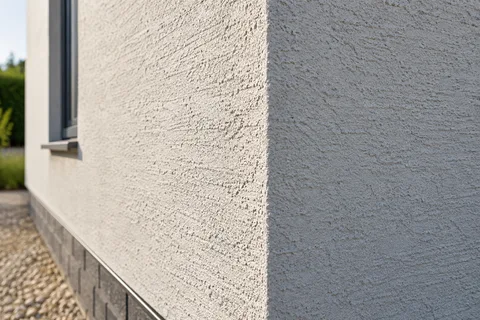
Look at the elevation as a whole. Note flaking, chalky areas, stains, cracks, old patches and parts that appear to have a different texture. Photograph those variations before washing changes their appearance. A uniformly dirty wall and a wall with several generations of coating may need very different preparation even if both look ready for a new colour from the road.
Describe the desired result clearly. If the aim is a fresh shade on a sound surface, a compatible coating may be appropriate. If the aim is to make coarse pebbledash smooth or conceal raised repairs, colour alone will not deliver that change. The assessment should address the intended finish, not simply establish whether another coat can physically be applied.
| Question | What it informs |
|---|---|
| Which layers are present? | Compatibility of the new system |
| Where is adhesion weak? | Extent of removal or repair |
| How does cleaning affect it? | Safe preparation and expected appearance |
| Is it ready for coating? | Sequence and application timing |
Distinguish the layers that could fail
Failure can occur between paint coats, between paint and render, within the render or at the bond to the masonry. A test of one interface does not automatically establish the condition of all the others. Ask the contractor to explain what is being assessed and how the result relates to the proposed work. Avoid reducing the discussion to a single claim that the wall has passed a test.
The method should suit the coating and system under consideration. This guide does not provide a do-it-yourself adhesion procedure or a universal pass value. The contractor or system adviser should specify appropriate testing and interpret it. Where destructive checks are required, agree their locations, extent and reinstatement before work begins.
Record variations between parts of the elevation. A sheltered area beneath the eaves may behave differently from a wet lower section or a previously repaired patch. If the wall contains several finishes, the assessment should account for them rather than selecting only the easiest place to test. The findings should identify the limits of what has actually been checked.
Use cleaning trials for a different purpose
A cleaning trial helps establish how a surface responds to the proposed method and whether the desired improvement is realistic. It does not by itself prove that the underlying render is securely attached. Keep the two questions separate. A wall may look much better after cleaning while still requiring repairs before any new coating is considered.
Discuss protection for windows, plants, paving and drainage before cleaning products or equipment are used. The chosen method should suit the existing finish and the manufacturer's guidance. More force is not automatically more effective, and an aggressive method can alter texture or damage a vulnerable surface. A discreet trial gives a chance to assess that risk before treating a prominent area.
Allow the relevant drying period before judging the result or moving to the next stage. A wet surface can look darker and more uniform than it will later. The readiness for coating should follow the specified system requirements, not the homeowner's impression that the wall feels dry in one accessible spot. Keep the sequence in the programme so drying is not treated as an unexpected delay.
Let the findings change the preparation
Where an earlier layer is unsuitable, the preparation may involve its removal or a different system. Ask how far removal must go and what condition is required afterwards. A proposal to remove loose material only should explain how the retained areas are assessed. Leaving an insecure layer beneath a new finish simply transfers the problem into the new work.
Render repair may be needed where the underlying surface is damaged. Those repairs must be compatible and ready for the intended decoration. Fresh patches can differ from older material in texture and absorption. The specification should identify how that variation is dealt with, including any primer required by the chosen system. An unspecified sealer is not a substitute for that explanation.
If significant areas are detached or the desired texture cannot be achieved by coating, consider wall rendering as a separate scope. The decision should be made before committing to a decorative treatment that cannot deliver the intended result. A more extensive project may be justified, but the reasons should be tied to the condition and brief rather than a blanket preference for replacement.


Test the colour after compatibility is established
Once the proposed system is suitable, use a dry sample to choose the appearance. Put it beside retained brickwork or window frames and view it under the conditions that affect the wall. If the elevation is broad, remember that a small pale sample can appear brighter when repeated over a much larger area. Keep the agreed reference with the product specification.
The texture underneath will usually remain visible. A coating can reduce differences in colour without flattening a rough surface or a proud patch. If the sample shows those features, decide whether they are acceptable. Do not approve it on the assumption that a further coat will necessarily hide them. The sample should represent the intended build-up and application, not an idealised finish that will not be repeated.
Render respray and hand application should be considered in relation to the material and surroundings. Spraying may require different masking and weather arrangements. The application method is not evidence that the preparation can be reduced. Ask for the complete sequence, including protection, repairs, primer where specified, finish and reinstatement of any removed fittings.
Retain the evidence for maintenance
Keep the assessment findings, test locations, preparation record and final coating details. If a problem develops later, those records help distinguish a coating issue from a new defect in the wall or a leaking fitting. Photograph the completed elevation and note any areas deliberately left untreated. A future contractor should not have to assume that every part received the same work.
For an external wall insulation system, use the system holder's guidance on decoration and alterations. For an older lime finish, consider the compatibility of the coating with the construction. These are reasons to identify the existing system accurately rather than select a paint only by colour. The products available for one wall may not be appropriate for another nearby property.
Keep the trial record after the coating is complete, including its location and the preparation used. A later repair or colour change can then distinguish the tested system from an unrelated paint subsequently applied elsewhere. If the main project used a different preparation from the trial, record why the change was accepted and what evidence supported it. The test should describe the work actually carried out.
The rendering services guide for Sutton-in-Ashfield explains where colour changes sit alongside repairs and replacement. A successful assessment may confirm a straightforward coating scheme, or it may show that preparation is the larger part of the job. Either result is useful when it is explained before work starts and reflected in the written scope.
Common questions
Is a clean surface automatically ready to coat?
No. Cleaning can remove dirt while leaving weak material, chalking, incompatible paint or dampness. The specified preparation and checks still apply. Establish how the substrate will be assessed after cleaning, how long it needs to dry under the chosen system guidance and who decides that it is ready for the next stage.
See housing and planning information for Sutton-in-Ashfield and nearby places, including the source and geography behind each figure.