Render colour changes in Sutton-in-Ashfield
Render colour changes in Sutton-in-Ashfield
Changing the colour of an existing rendered wall may avoid a complete replacement where the background remains suitable. The key question is whether the surface can carry the proposed treatment. Respray describes an application method; it does not tell you whether repairs, cleaning, primer or a different approach are needed before the colour goes on.

On this page
Separate a colour problem from a surface problem
List what you want to change. The finish may be sound but faded, unevenly stained, marked by repairs or simply the wrong colour for new windows. These situations can lead to different preparation requirements. Photograph the whole elevation before cleaning so the person assessing it can see the distribution of marks and any relationship with gutters, sills or ground levels.
Loose render, an unstable coating and recurrent cracking need assessment before decoration. Covering those defects can make the wall look more uniform briefly without dealing with the failure beneath it. Ask which repairs are included and how their completion will be checked before coating. If the main problem is loss of bond over a wide area, a replacement finish may need consideration instead.
Do not treat every dark mark as dirt that can simply be washed away. Water runoff, surface growth and material changes can produce different patterns. The proposed cleaning method should suit both the finish and the cause being addressed. Aggressive washing can damage a surface, and cleaning products need the relevant application and protection measures. A discreet trial helps establish the likely result without committing the entire façade.
| Work item | What to clarify |
|---|---|
| Cleaning | Method, test area and protection |
| Repairs | Extent and readiness for coating |
| Decoration | Compatible primer and finish |
| Appearance | Dry sample and retained texture |
- Clean Washed down, with algae and mould treated and left to work.
- Repair first Cracks and hollow patches are repaired before any coating.
- Prime or stabilise Where the coating maker requires it on that surface.
- Coating Usually two coats of a breathable masonry or silicone coating.
The usual order of work. The survey and the chosen products decide the actual steps.
Find out what you are coating
Identify the existing system and any earlier paint if records are available. Keep product names, dates and samples with the survey information. The contractor should assess adhesion and compatibility before choosing a new coating. A description such as exterior masonry paint is too broad to establish suitability for every render, particularly where an insulated or traditional lime system is involved.
Existing coatings can fail between layers rather than at the masonry. Adding a new layer may increase the number of interfaces without addressing the weak one. Ask what testing or removal is proposed and how the result will affect the specification. If the assessment identifies a product that should not be overcoated in the planned way, the preparation and programme need to change accordingly.
Repairs must be ready for decoration under the relevant product instructions. A fresh patch and an older wall can absorb or retain moisture differently. Primer may be specified as part of the system, but should not be presented as a universal cure for every variation. The written proposal should connect the background assessment to the actual preparation and coating products.
Judge samples on the real elevation
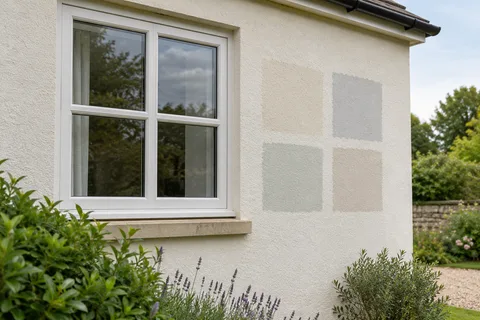
Choose a small shortlist of colours and test them where the work will be seen. Include a position close to the existing brick or window frames, rather than an isolated board in different surroundings. Allow the sample to dry before deciding. Look at it in ordinary overcast light as well as any direct sun the wall receives during the day.
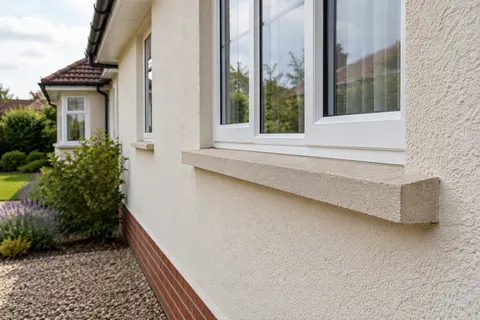
Large pale surfaces can look brighter than a small sample suggests. On a bungalow, a low roof and a long front wall make the relationship with the fascia particularly noticeable. Consider the front door, paving and planted areas too. A slightly different tone on a porch can be attractive, but it should be an intentional choice recorded in the scope rather than a difference discovered after application.
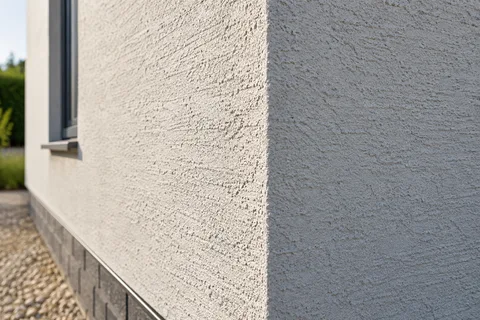
Texture will remain part of the result. Coating pebbledash does not turn it into a smooth render, and a patch that stands proud may still be visible after the colour is unified. If the desired result is a substantially different surface, discuss wall rendering or pebbledash removal before deciding on a coating. The right comparison is the finish you want against the work needed to achieve it.
Plan masking, access and reinstatement
Spray application needs suitable protection for windows, roofs, vehicles, paths and neighbouring property. Ask how the working area will be arranged and how changing wind conditions affect the method. Hand application may be preferable or necessary in some parts. The method should follow the product and site assessment, not a claim that one technique automatically produces a better result everywhere.
Fittings can create uncoated strips and awkward edges. Decide whether lights, house numbers, downpipes or other attachments are removed, masked or worked around. Electrical and other specialist items may require the appropriate trade. Photograph their positions and identify who reinstates them. A coating scheme should not make inspection covers or vents unusable or leave equipment attached through an unsuitable detail.
Allow safe access to remain while protection is in place. A front entrance may need a different sequence from the garden elevation. Tell the contractor about deliveries, mobility needs and any door that must stay usable. These practical details affect the programme and can prevent temporary sheets or equipment from turning everyday access into a problem.
Understand the limits of a refreshed colour
Render repair should be completed and reviewed before the wall is recoloured. The coating can unify shade, but it should not be relied upon to close significant movement cracks or bridge a poorly formed joint. If a defect reappears, its cause still needs investigation. A decorative finish is one part of maintaining the exterior, alongside the fittings that keep water off it.
Keep the coating name, colour reference, application date and maintenance guidance. A spare label or digital photograph is useful when a small area is altered later. Do not assume that a touch-up from an old container will blend perfectly after the wall has weathered. Its condition and storage history matter, and the surrounding finish may have changed since the original application.
For an insulated façade, follow the system holder's advice on maintenance and decoration. For lime work, confirm the compatibility of the proposed finish with the existing construction. Those checks may rule out an otherwise attractive product. A successful colour change should leave a maintainable wall, not simply deliver a new shade at the expense of the system beneath it.
Common questions
Is a new colour enough for hairline cracks?
A coating is not a diagnosis or a substitute for the specified repair. Record the crack locations and ask whether they are stable, whether the background remains bonded and what preparation the coating system requires. Ongoing movement or moisture needs separate attention before the decorative stage can be sensibly agreed.
See housing and planning information for Sutton-in-Ashfield and nearby places, including the source and geography behind each figure.